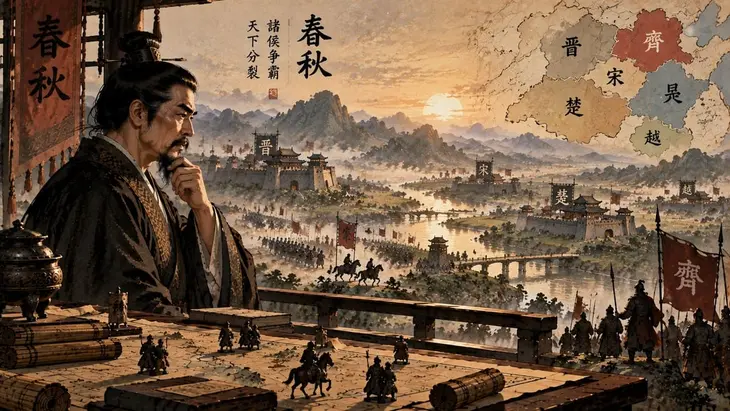
To place Sun Tzu in ancient China, it is useful to distinguish the political framework of his era, the conflicts associated with him, and the resources needed to wage war. This overview connects the 6th century BC with the fragmentation of Zhou power and the rivalry between Wu and Chu, without confusing historical context with proof of a biography.
The Zhou power and the states of the 6th century BC
During the Spring and Autumn period, the authority of the Zhou kings weakened while regional rulers increased their autonomy. The territories linked to the dynasty had different capacities to raise troops, obtain resources, and exert influence over their neighbours. In the 6th century BC, understanding a war requires attention to these relations between states, not imagining a territory governed uniformly from a single court.
Relations between states were not limited to combat either. Meetings between rulers, diplomatic missions, and alliances formed part of political activity. The expression “constant war” describes an environment of recurrent conflicts, but it does not mean that all states were fighting simultaneously or that negotiation had disappeared.
A brief chronology for orientation
- 771–770 BC: the crisis of the Western Zhou and the court’s move to the Luoyang area open the framework of the Eastern Zhou, whose first part is identified with the Spring and Autumn period.
- Late 6th century BC: the framework of the tradition linking Sun Tzu with Helü, king of Wu, and with the confrontations against Chu. This reference places the narrative in context, without turning all its attributions into corroborated facts.
- 476–475 BC: one of the conventions used to separate the Spring and Autumn period from the Warring States period. Other chronologies use different limits, such as 481 BC; the division does not describe an instant political transformation.
The study of the features of the Spring and Autumn period develops the political organisation, rivalries, and social and military changes. It is the route to understanding the evolution of the period beyond these chronological references.
A basic map of the states
As a general guide, Qin was located in the west; Jin, in the north; and Qi, towards the east. In the southern sphere, Wu occupied the area at the mouth of the Yangtze, to the east of Chu. This outline helps place the key players without confusing their territories with today’s administrative divisions or assuming that their borders remained fixed.
Wu and Chu: from the political framework to a specific rivalry
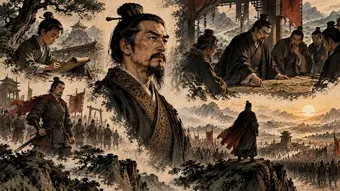
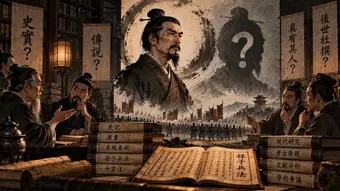
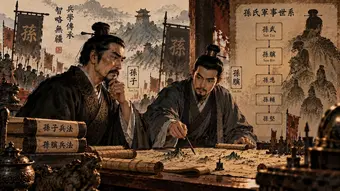
Sun Tzu’s connection with Wu comes from the biographical tradition passed down by Sima Qian. His account presents him in the service of Helü and links him with the kingdom’s military successes. This attribution should be kept separate from the study of the conflict: reconstructing a war between states and establishing an individual’s decisions are different tasks.
The overview of the conflict between Wu and Chu explains the actors, the territories, and the course of their clashes. It makes it possible to address specific questions: what relationships they maintained with other states, how each kingdom’s situation changed, and what conditions a campaign had to take into account.
In 506 BC, Wu defeated Chu at Boju and advanced to its capital, Ying. The victory provides a concrete historical reference, but it does not by itself prove that Sun Tzu directed every operation. The analysis of the campaign of Wu and the Battle of Boju distinguishes the military development from the attributions about his involvement.
The resources that shaped a campaign
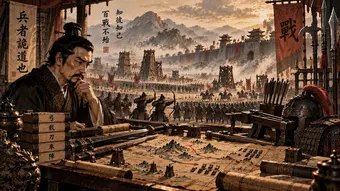
The treatise attributed to Sun Tzu pays attention to the cost of mobilising chariots and troops, transporting supplies, and maintaining weapons. It also warns of the exhaustion that a prolonged campaign can produce. These issues make it possible to connect strategic reading with material problems, without taking the figures in the text as an accounting record of a particular army.
To study these problems, it is useful to ask what had to be moved, by which route, and for how long. A force on the move needs to maintain access to its supplies; having soldiers does not in itself solve the transport of food or the replacement of equipment. These are different aspects of the same operation and should be examined alongside its objectives.
The guide to war and weaponry in ancient China organises the overview of chariots, infantry weapons, and logistics. When comparing these means, the periods and the available evidence must be distinguished: a military reference in the treatise and an archaeological object do not allow exactly the same questions to be answered.
Historical context helps to interpret the problems addressed by The Art of War, but it does not by itself allow each passage to be dated or prove that a campaign inspired a specific teaching. The relationship between an idea and an event needs its own documentation.