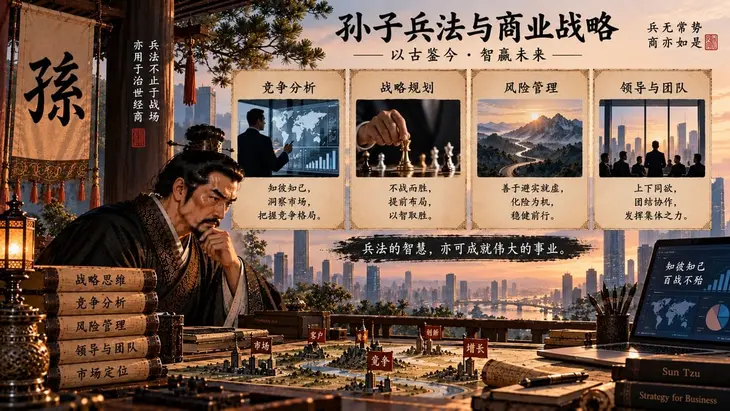
Reading Sun Tzu through business makes it possible to ask where to compete, which resources to commit, and what information is missing before making a decision. This guide organises those interpretations through business vocabulary, the situation of a start-up, crises and competitive intelligence. The examples are hypothetical and do not describe guaranteed outcomes.
From military vocabulary to business decisions
Transferring a military idea to a business requires explaining the comparison. Terrain can be used as an image of the market; the forces available, as a reference to resources and coordination. These equivalents help to frame questions, but they do not turn an organisation into an army or fully describe a commercial relationship.
For example, interpreting the market as terrain may lead you to examine what needs exist, what alternatives the buyer has, and what conditions a business faces when offering its service. The question ceases to be how to conquer a space and becomes what the organisation can contribute there.
The journey through Sun Tzu’s vocabulary in business develops these correspondences and their limits. Competition is part of the analysis, but customers, suppliers and employees do not need to become enemies in order to understand their interests.
Before using a metaphor, identify the decision you want to examine. Choosing an activity, responding to a disruption and studying another company require different information. An overly broad comparison can hide those differences rather than clarify them.
Three situations for studying business strategy
A start-up versus a larger company
Imagine a small software company trying to reproduce all the features of an established platform. In this hypothetical case, the first question would be which part of the product it can develop and maintain with its resources. Adding features to the product range does not prove it can provide them at the intended level of service.
The alternative suggested by this exercise is to examine a specific need before broadening the scope. It would be necessary to define who has that problem, how they currently solve it, and what difference would justify trying another solution.
The analysis of a start-up strategy versus a giant develops that relationship between focus, resources and differentiation. Being small is not, by itself, an advantage: the proposal needs to address a need that can be verified.
A crisis and the need to organise decisions
In another scenario, a company temporarily loses a supplier needed to fulfil its deliveries. The urgency can be studied by separating what has happened from what is still unknown: which orders are affected, which alternatives need to be checked, and who is coordinating the information.
The reading of Sun Tzu in a business crisis examines the metaphor of an extreme situation. Its usefulness here lies in organising responsibilities and priorities, not in creating extreme pressure to demand more effort from the team.
A military image also does not determine which costs should be cut or how to resolve the risk of insolvency. Concrete financial or insolvency decisions need a professional assessment of the situation; they cannot be deduced from a maxim about survival.
Competitive intelligence: gathering, comparing and interpreting
Studying another company requires distinguishing published information from the conclusions drawn from it. A catalogue shows an advertised offer, but it does not necessarily explain the organisation’s full capability. The absence of a service from that catalogue does not by itself prove that it cannot provide it.
The guide to competitive intelligence with open sources organises the analysis of public information. The journey separates data collection, comparison and the interpretation of what is found.
In a practical exercise, the source of each observation, the date and the question it helps answer can be noted alongside it. Anything that remains a supposition should retain that status. This approach does not include obtaining confidential documents or asking former employees of a competitor for secrets.
Separating business strategy, leadership and marketing
Deciding what activity an organisation can sustain does not resolve how its team should be led. Autonomy, supervision and work expectations are covered in Sun Tzu applied to leadership. There the focus shifts from the company’s position to the responsibilities of those who work within it.
It is also worth distinguishing the ability to offer a service from the way it is presented and its terms negotiated. The guide to Sun Tzu in marketing and negotiation addresses channels, value proposition, agreements and price. Keeping these questions separate makes it easier to identify which part of a decision needs reviewing.
From military vocabulary to business decisions
Transferring a military idea to a business requires explaining the comparison. Terrain can be used as an image of the market; the forces available, as a reference to resources and coordination. These equivalents help to frame questions, but they do not turn an organisation into an army or fully describe a commercial relationship.
For example, interpreting the market as terrain may lead you to examine what needs exist, what alternatives the buyer has, and what conditions a business faces when offering its service. The question ceases to be how to conquer a space and becomes what the organisation can contribute there.
The journey through Sun Tzu’s vocabulary in business develops these correspondences and their limits. Competition is part of the analysis, but customers, suppliers and employees do not need to become enemies in order to understand their interests.
Before using a metaphor, identify the decision you want to examine. Choosing an activity, responding to a disruption and studying another company require different information. An overly broad comparison can hide those differences rather than clarify them.
Three situations for studying business strategy
A start-up versus a larger company
Imagine a small software company trying to reproduce all the features of an established platform. In this hypothetical case, the first question would be which part of the product it can develop and maintain with its resources. Adding features to the product range does not prove it can provide them at the intended level of service.
The alternative suggested by this exercise is to examine a specific need before broadening the scope. It would be necessary to define who has that problem, how they currently solve it, and what difference would justify trying another solution.
The analysis of a start-up strategy versus a giant develops that relationship between focus, resources and differentiation. Being small is not, by itself, an advantage: the proposal needs to address a need that can be verified.
A crisis and the need to organise decisions
In another scenario, a company temporarily loses a supplier needed to fulfil its deliveries. The urgency can be studied by separating what has happened from what is still unknown: which orders are affected, which alternatives need to be checked, and who is coordinating the information.
The reading of Sun Tzu in a business crisis examines the metaphor of an extreme situation. Its usefulness here lies in organising responsibilities and priorities, not in creating extreme pressure to demand more effort from the team.
A military image also does not determine which costs should be cut or how to resolve the risk of insolvency. Concrete financial or insolvency decisions need a professional assessment of the situation; they cannot be deduced from a maxim about survival.
Competitive intelligence: gathering, comparing and interpreting
Studying another company requires distinguishing published information from the conclusions drawn from it. A catalogue shows an advertised offer, but it does not necessarily explain the organisation’s full capability. The absence of a service from that catalogue does not by itself prove that it cannot provide it.
The guide to competitive intelligence with open sources organises the analysis of public information. The journey separates data collection, comparison and the interpretation of what is found.
In a practical exercise, the source of each observation, the date and the question it helps answer can be noted alongside it. Anything that remains a supposition should retain that status. This approach does not include obtaining confidential documents or asking former employees of a competitor for secrets.
Separating business strategy, leadership and marketing
Deciding what activity an organisation can sustain does not resolve how its team should be led. Autonomy, supervision and work expectations are covered in Sun Tzu applied to leadership. There the focus shifts from the company’s position to the responsibilities of those who work within it.
The modern applications of Sun Tzu bring these journeys together with those devoted to sport and everyday life. In each adaptation, identify which question the comparison helps to frame and what additional information is needed to answer it.