
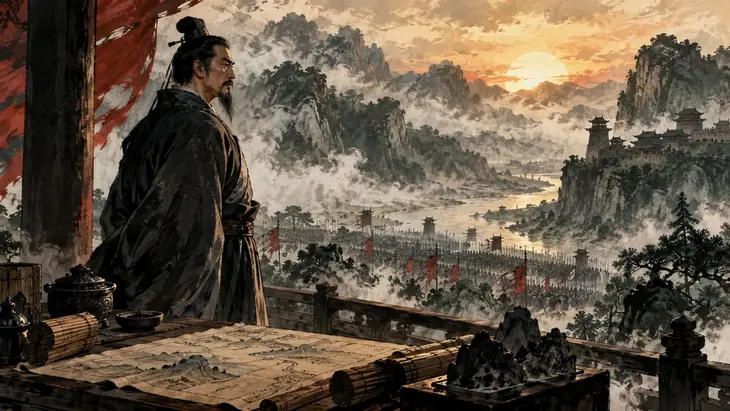
Sun Tzu is the strategist from the Chinese military tradition to whom The Art of War is attributed. Here you can get closer to his figure, understand the ideas in the treatise, and explore its contemporary reinterpretations, distinguishing history and legend from analysis of the text and its modern applications.
What The Art of War proposes
The Art of War studies how to prepare for and conduct a conflict by paying attention to resources, terrain, command and the information available. An army’s strength is only part of the problem: the cost of mobilising it, the length of the campaign and the ability to adapt to circumstances also matter.
Among its ideas are assessment before acting, knowledge of one’s own capabilities and those of the opponent, and the search for a victory that avoids a destructive confrontation. It is worth reading them within their military context before transferring them to a company, a competition or an everyday decision.
Four ways to explore Sun Tzu
History: the figure behind the name
What is said about Sun Tzu’s life, and what support do those accounts have? Approaching his biography requires distinguishing tradition, the sources that transmit it, and the questions that remain open. The context of ancient China also helps to place political rivalries and the material conditions of war.
The section on the history and context of Sun Tzu brings together his life and legend, the debate about his existence, the figure of Sun Bin, and the weapons and tactics of the period. It is the right starting point for getting to know the character without confusing a traditional attribution with a proven fact.
The book: reading, chapters and translations
To understand the treatise, it is worth following the relationship between its themes: the preliminary calculations, the cost of conflict, the deployment of forces, manoeuvres, terrain and the gathering of information. An isolated sentence leaves out much of that journey.
The guide to The Art of War organises access to chapter analyses and to the study of its manuscripts and translations. It lets you begin with strategic preparation and continue towards issues of command and adaptation, or go to the section that answers a specific question.
Philosophy: understanding the strategic ideas
Adaptability, military deception, self-knowledge and the ideal of winning without fighting raise different questions. How do you adjust a plan when the situation changes? What information is missing before deciding? What does it mean to achieve an objective without destroying what one seeks to preserve?
The section on Sun Tzu’s strategic philosophy lets you study these ideas by theme rather than following the order of the chapters. It also opens the path to Taoist readings and comparisons with other thinkers, distinguishing interpretative affinities from demonstrated historical relationships.
Applications: reading Sun Tzu from the present
Business, leadership, marketing, sport and everyday life offer settings in which to reinterpret his ideas. In these readings, observing the environment or reviewing one’s own resources can become a useful question for analysing a current situation. That adaptation is not the same as a literal teaching from the treatise on companies or personal relationships.
The modern applications of Sun Tzu explore those parallels and their limits. The aim is to reflect on decisions, coordination and conflicts, without turning customers, colleagues or family members into enemies or presenting a military metaphor as a guarantee of success.
Frequently Asked Questions
Are Sun Tzu and The Art of War the same thing?
No. Sun Tzu is the name traditionally used for the Chinese strategist associated with the work, whereas The Art of War is the military treatise attributed to him. The relationship between the historical figure and the formation of the text presents documentary problems that are best studied separately.
Where is it best to start if this is the first time I have read about Sun Tzu?
It depends on your initial question. To place the figure and his era in context, it is best to begin with the historical section. To get to know the work, its structure and its chapters, it is more useful to go to the section devoted to The Art of War. If your interest lies in ideas such as deception, adaptation or victory without combat, it is more appropriate to consult the content focused on his strategic thought.
Why are there doubts about some details of Sun Tzu’s life?
Because the surviving documentation does not allow all the traditional episodes to be verified with the same degree of certainty. One of the best-known ancient sources is the Shiji or Records of the Grand Historian by Sima Qian, written centuries after the period in which Sun Tzu is traditionally placed. For that reason, it is worth distinguishing between ancient accounts, historical evidence and later interpretations.
What is the difference between studying Sun Tzu and studying The Art of War?
They are related questions, but different ones. The study of Sun Tzu tries to establish who he may have been, when he lived and how reliable the accounts of his life are. The analysis of The Art of War deals with the content, structure, textual transmission and interpretation of the treatise.
Do you need to know Chinese history to understand Sun Tzu?
It is not essential for a first reading, although knowing the context helps when interpreting references to armies, terrain, supplies, sieges, political command or espionage. Many of those concepts belong to forms of military organisation very different from those of today.
Do the thirteen chapters of The Art of War have to be read in order?
Not necessarily. The treatise can be read from beginning to end or consulted by specific themes. When you want to interpret a particular sentence or idea, it is worth reviewing the full chapter in which it appears to avoid taking the passage out of context.
How do you distinguish a teaching of Sun Tzu from a modern interpretation?
You have to separate what appears in the treatise from the applications developed later. Using ideas from The Art of War in business, leadership, negotiation, sport or personal development involves transferring military concepts to contexts that do not appear in the original text.
Why do Sun Tzu’s phrases change depending on the translation?
The Art of War was written in Classical Chinese and there are numerous translations made in different periods and languages. The same expression may allow several solutions depending on the translator’s criteria and the edition used. Some widely circulated phrases are also modern paraphrases rather than literal renderings of the ancient text.
What happens when sources do not agree about Sun Tzu?
Differences should be noted rather than presenting a disputed version as a certain fact. It is worth checking when each source was written, what information it provides and how much time separates it from the events it describes.
Do Sun Tzu’s current applications explain the original meaning of his work?
Not always. A contemporary application may use a principle from the treatise as a starting point, but that does not prove it has exactly the same meaning it had in its historical context. The analysis of the original text and its modern uses should be kept distinct.
Where to start
For a first approach, start with the history and then move on to the guide to the book. That order makes it possible to separate what is said about Sun Tzu from what is analysed in the treatise. Afterwards, you can choose a concept and follow its connections with other passages.
If you arrive with a question about leadership, business or everyday life, begin with the modern applications and then return to the concept that supports the comparison. Keep one distinction in mind while reading: what belongs to the historical account, what comes from the text, and what is proposed by its current interpreter.