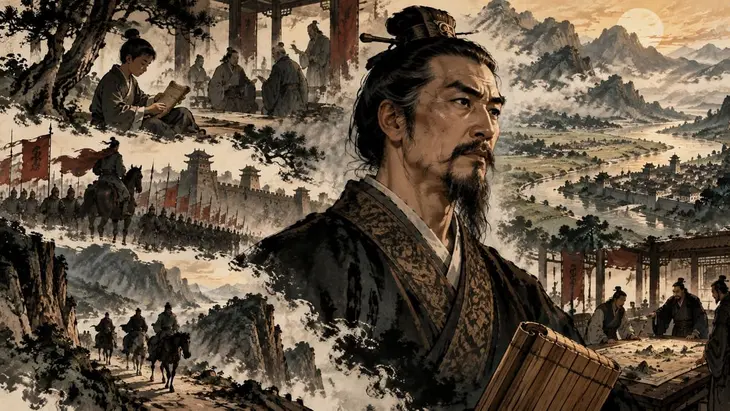
The history of Sun Tzu brings together the biography handed down by tradition, the conflicts of ancient China and the questions about the authorship of The Art of War. This overview helps place the strategist in his era, distinguish him from Sun Bin, and understand what the historical accounts and surviving manuscripts contribute.
A timeline for placing Sun Tzu
The period attributed to Sun Tzu, the writing of the accounts of his life, and the discovery of manuscripts are different moments. Separating them avoids reading a later narrative as though it were a contemporary account of the events.
- 6th century BC, during the Spring and Autumn period: the historical setting of the tradition linking Sun Tzu with the state of Wu and King Helu. This reference guides reading, but does not by itself fix a date of birth or prove his involvement in every campaign.
- Warring States period: the context of Sun Bin and the military treatise attributed to him. His career should be studied separately from the traditional biography of Sun Tzu.
- 1st century BC: the Shiji, or Records of the Grand Historian, by Sima Qian, includes the biographical account of Sun Tzu, several centuries after the period in which he is placed.
- 1972: discovery of the Yinqueshan bamboo manuscripts. This is the date of the modern find, not of the composition of the ancient texts recovered.
Five pathways through his history
Sun Tzu’s life and the limits of his biography
Questions about his origins, his rise to command and the end of his life form the biographical path. The episodes linked to King Helu and the campaigns of Wu require a reading that distinguishes what a source says from what can be corroborated by other means.
The guide to the life and legend of Sun Tzu organises those episodes and gives access to their specific analysis. It lets you follow the narrative without turning documentary gaps into supposedly known dates, victories or personal circumstances.
The Spring and Autumn context
Studying the period shifts attention from the individual to the states, their rivalries and the resources available for warfare. The organisation of power under the Zhou and the conflict between Wu and Chu help explain the setting in which the accounts of Sun Tzu are placed.
The Spring and Autumn context connects that historical framework with conflicts and military means. Here the question is how that environment worked, not which decisions can be attributed personally to the strategist.
The debate over his existence and the authorship of the treatise
The existence of a historical figure and the authorship of a book are separate questions. So too is determining how the transmitted text came together: recognising that difference makes it possible to examine each problem without making every answer depend on a single piece of evidence.
The debate over Sun Tzu's existence brings together the study of biographical testimonies, hypotheses about the composition of the treatise and the distinction from Sun Bin. A lack of information does not by itself prove that a figure is fictitious; nor does a biographical narrative automatically confirm every episode.
Sun Bin and his own military tradition
The figure of Sun Bin opens a path into another career and another treatise. His relationship with Pang Juan, the accounts of Maling and the comparison between the works make it possible to address questions different from those raised by the life of Sun Tzu. The possible family link between the two requires a separate examination from the identification of their texts.
The section devoted to Sun Bin and his military treatise organises those readings without confusing the authors or presenting a genealogy as proven merely by the similarity of their names.
How warfare was conducted in ancient China
Chariots, infantry weapons and supplies make it possible to study the material conditions of a campaign. Feeding troops, transporting resources and moving across different terrain create problems that cannot be solved by tactical decisions alone.
The guide to warfare and weapons in ancient China introduces these means and their limitations. It distinguishes the treatise’s references from material evidence and avoids grouping weapons from different periods together as though they had all belonged to the same army.
The sources: biographical accounts and manuscripts
Narrative texts and archaeological finds answer different questions. To study a biography, it matters who relates an episode, when it is written and what independent support exists. In the case of a manuscript, one must distinguish the surviving medium, its dating and the work it contains.
The analysis of Sima Qian's records on Sun Tzu makes it possible to examine the account in the Shiji and the distance between its writing and the events narrated. Its value as a source requires considering both the information it conveys and its limits for corroboration.
On the other hand, the Yinqueshan bamboo manuscripts offer an entry point into the study of textual transmission and the works attributed to Sun Tzu and Sun Bin. Recovering an ancient witness to a treatise does not amount to verifying the entire life of its supposed author, nor to confirming every later version unchanged.