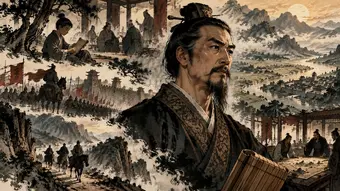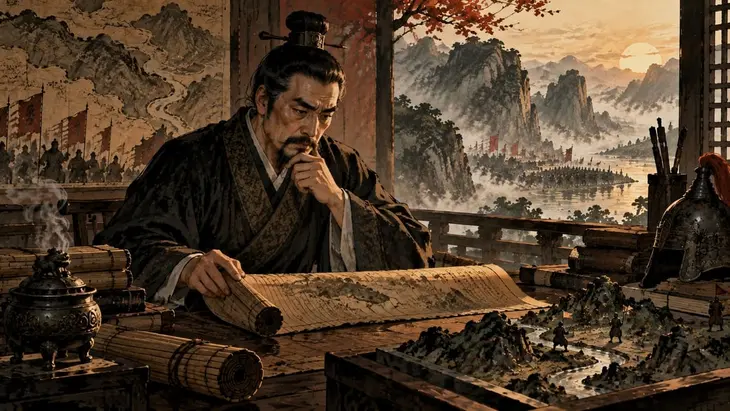
Reading The Art of War requires connecting its ideas, not just taking isolated phrases on their own. This guide organises the journey through the treatise into four blocks of chapters and a section devoted to manuscripts and translations. You can follow the order of the book or begin with the question you want to answer.
How to approach reading the treatise
The numbering used here follows the traditional structure of thirteen chapters. We group them into four blocks to make reading easier; that grouping is a proposal of this guide and not an additional division in the ancient text.
On a first reading, it is worth identifying what problem each chapter addresses before trying to draw a general lesson. Is it weighing up whether to act, organising a force, interpreting a situation, or seeking information? That question helps preserve the context when the same idea appears in different passages.
It is also worth separating the translated text from the explanations in an edition. A commentary may clarify an expression or suggest an interpretation, but it should not automatically be read as part of the words attributed to Sun Tzu.
The thirteen chapters in four reading blocks
Chapters 1 to 3: assessment, costs and priorities
The opening of the treatise links prior calculations with the cost of sustaining a campaign and the priorities of attack. The decision to fight appears tied to the conditions under which the conflict is undertaken.
The starting point is the study of the five factors in chapter 1. Before turning them into a list to memorise, it is worth asking what each one allows us to assess and what information would be needed to compare them.
The perspective then changes: from preparing a decision to examining what it costs to sustain it. By chapter 3, you can see how objectives are related to the means used.
Chapters 4 to 7: force deployment and manoeuvres
This block brings together defensive dispositions, the combination of forces, the relationship between strengths and weaknesses, and the problems of movement. Preparing a position and taking advantage of an opportunity are related questions, but they are not the same.
The guide to positioning and tactics: chapters 4 to 7 organises that journey. To follow it, it is useful to distinguish what depends on one’s own organisation from what requires observing the adversary’s decisions.
Chapters 8 to 11: adaptation, observation and terrain
The following chapters address the changing of decisions, observation during marches, topography and the different situations of the army. Their classifications respond to different problems and do not form a single interchangeable list.
The journey through terrain and adaptation: chapters 8 to 11 lets you study each problem in its proper place. One way to orient yourself is to separate what is observed in the environment, the interpretation made of it, and the decision proposed.
Chapters 12 and 13: fire and intelligence
Chapter 12 addresses fire attacks and the conditions that should be considered before using them. Chapter 13 deals with obtaining information through spies.
Reading fire and intelligence: chapters 12 and 13 provides separate access to both themes. In this final stretch, it is important to distinguish between having a means available, considering it worthwhile to use it, and having enough information to decide.
Manuscripts and translations: how to study the text you are reading
Another way into the book is to ask how it has been preserved and how it has been translated. A manuscript, a translation and a commentary are different objects of study: identifying the title of the work is not enough to know which version you have in front of you.
The section on Sun Tzu manuscripts and translations organises the journey through Yinqueshan and through different translations of the treatise. It allows you to approach the transmission of the text without mixing it up with a specific analysis of its chapters.
To compare editions, you can choose the same passage and observe how its terms are rendered, what the notes explain and where the commentary comes in. The comparison between Giles and Griffith develops those criteria. Choosing a translation depends on the kind of reading you want to do.
If you prefer to follow one idea across several chapters, continue with Sun Tzu's strategic philosophy. To connect that study with the history of the figure and current reinterpretations, the guide to Sun Tzu and his work brings together the other paths through the site.