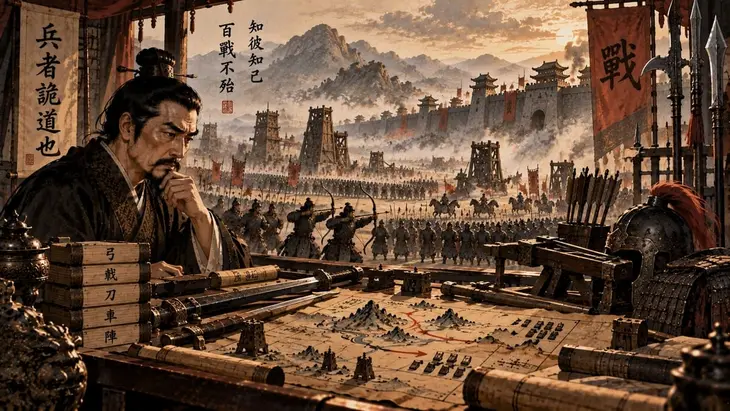
To understand the military references in The Art of War, it is worth asking how forces moved, what means they used, and how they were sustained during a campaign. This guide connects mobility, weaponry, and supply, distinguishing what the treatise describes from what archaeological objects allow us to study.
Mobility: chariots and infantry in relation to terrain
Chapter 2 of The Art of War presents a force made up of chariots, soldiers, and supplies. Later, it includes in the costs the wear of vehicles and the exhaustion of animals. Movement is thus linked to upkeep, not treated as a capability independent of resources.
In material terms, a wheeled vehicle needs space to move and manoeuvre, as well as a surface that can support its load. A force on foot poses different demands. Comparing them requires asking about the road, the distance, and the equipment carried, rather than assigning each means an advantage that applies to any terrain.
The guide on Chinese war chariots develops their components, functions, and limitations. It makes it possible to study separately the vehicle used in combat and the transport needs of a campaign, without assuming that all chariots had the same configuration.
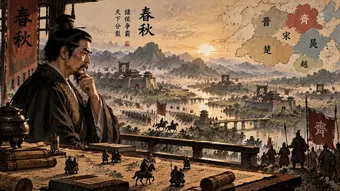
To place these questions in the era traditionally associated with Sun Tzu, the Spring and Autumn period context provides the historical framework. It is worth keeping this separate from the dating of each weapon or passage: a general reference to ancient China is not enough to make all its military means contemporaneous.
Weaponry: function, form, and chronology
A sword, a polearm, and a missile weapon raise different issues of range and close contact. To compare them, it is helpful to observe how they are held, what space their use requires, and what protection can be opposed to them. The name of a weapon, taken apart from its form and context, gives an incomplete description.
What an archaeological piece allows us to study
The Freer Gallery catalogue includes a fragment of a hooked dagger-axe from a tomb in Changsha, dated to the Eastern Zhou. The piece offers a concrete material reference for studying that type of weaponry.
Its form and origin can be examined directly, but they do not by themselves describe the equipment of all armies. To reconstruct a military assemblage, it would be necessary to relate it to other finds and to its context, without turning a single object into a universal model.
The crossbow as a reference in the treatise
In chapter 5, the treatise compares stored energy to a drawn crossbow and decision to the release of its mechanism. The image helps explain the relationship between preparation and execution, although it does not constitute a complete description of its military use.
Victor H. Mair uses technological references, including the crossbow, when discussing the text’s dating. His analysis reminds us that placing the traditional author in a period does not automatically date every element of the surviving version.
The tour of the weapons of ancient China organises the study of bronze swords, polearms, and the crossbow. The comparison must preserve chronological and terminological differences, without grouping them as though they made up the standard equipment of a single soldier.
Supply: sustaining the army during a campaign
Chapter 2 links the length of war with the wear on weapons, the transport of supplies, and the exhaustion of resources. It also mentions seemingly minor maintenance materials such as glue and paint, alongside chariots and armour.
The practical result is that counting combatants is not enough to describe an available force. One has to consider what they can carry, how much they consume, and what happens when they need equipment replaced. Adding personnel increases the needs that supply must meet; it does not by itself solve how to cover them.
The guide to the logistics of ancient armies develops questions about food, animals, transport, and the duration of operations. That material journey helps examine a campaign without reducing its outcome to a single manoeuvre.
To follow the book’s argument, the cost of war in chapter 2 studies the relationship between expenditure and wear. The quantities used in the treatise should be read within that line of reasoning, not used directly as a verified budget for a historical army.
When you come across a reference to chariots, weapons, or supplies, first identify whether it comes from the treatise, a material find, or a modern reconstruction. Then ask what specific limitation it introduces: movement, range, maintenance, or supply. In this way, the military means can be connected to strategic decision-making without attributing capabilities that the evidence does not support.