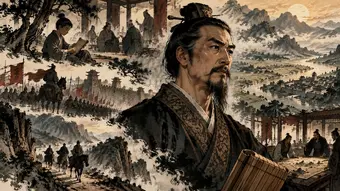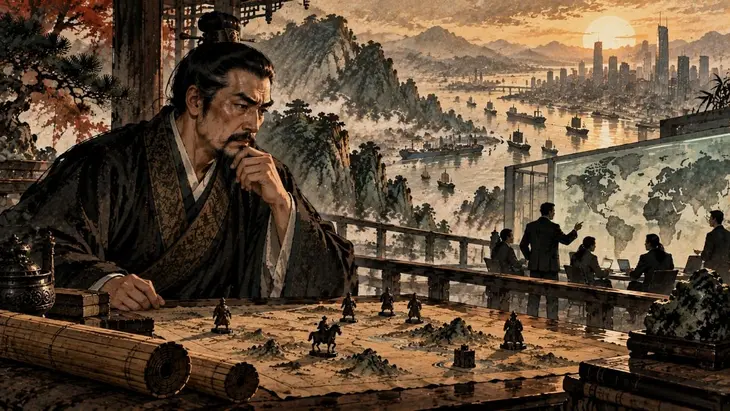
Applying Sun Tzu to the present requires explaining what is taken from the treatise and what is added by its interpreter. This guide brings together readings for business, leadership, marketing, sports, and everyday life. The examples suggest questions for reviewing decisions without turning a work or personal situation into a war.
What changes when a military idea is brought into the present
An adaptation begins by identifying the current problem. It is then possible to examine which comparison helps you think about it and where it stops being useful. Using strategic vocabulary without that prior step risks changing the names of things without explaining the situation any better.
For example, talking about the market as terrain can guide questions about the conditions in which a company operates. It does not turn buyers into territory to be conquered, nor does it make an organization and an army equivalent. The study of Sun Tzu’s vocabulary in business develops these correspondences as interpretive proposals, not as literal translations.
In the examples below, the intended usefulness is concrete: to frame a question, organize information, or make an assumption explicit. The analogy does not replace the data needed to decide, nor does it prove that an action will work.
Five areas of application
Business: linking the goal with the resources available
Imagine a small company trying to match the full product line of a larger competitor. A strategic reading might begin by reviewing what it can sustain with its own means, instead of assuming it must respond to every move the other company makes.
The practical question would be what specific need it can meet and what information is missing to verify the interest of its potential clients. The guide to Sun Tzu applied to business connects that assessment with readings on startups, crises, and competitive intelligence. Focusing on one activity does not guarantee that sufficient demand exists.
Leadership: clarifying who decides and how the work is reviewed
In a hypothetical team, all decisions wait for approval from one person, even when other leads know the task. The problem can be analysed by distinguishing which decisions need oversight and which could be delegated within agreed limits.
As an adaptation of the theme of command, the exercise consists of defining what each lead can decide, when they must consult, and how the result will be reviewed. Sun Tzu applied to leadership organises readings on virtues, autonomy, and people management. The comparison does not require transferring the discipline of an army to a modern organization.
Marketing and negotiation: defining what you are trying to achieve
Suppose a brand spreads its efforts across many channels because its competitors use them too. Before adding another campaign, it can ask a more precise question: what does it need to communicate, to whom, and what response does it expect to observe?
In this reinterpretation, allocating resources means linking each action to a verifiable purpose. The path of Sun Tzu in marketing and negotiation separates channel mix, the search for niches, commercial agreements, and the cost of competing on price. A military idea about deception does not justify misleading advertising or hiding the terms of a negotiation.
Sports and eSports: observing before repeating a plan
A team may prepare a play that, during the competition, does not find the expected opening. As an example of adaptation, the analysis consists of comparing what was expected with what is happening before insisting on the same execution.
The question would be what has changed and what alternative the rules allow. The guide to Sun Tzu in sports and eSports distinguishes team sports, regulated combat, digital competition, and preparation before the event. The comparisons should be understood within the characteristics of each activity.
Everyday life: reviewing a reaction and keeping boundaries
In a fictitious disagreement about dividing tasks, one person may prepare a response meant only to prove they are right. A reading inspired by avoiding wear and tear can begin with another question: what specific change needs to be agreed on to solve the problem?
The exercise consists of separating the request from the reproach, considering a pause, and stating what commitment each side can make. Sun Tzu in everyday life also opens paths on planning, everyday fears, and decisions under intense emotions. These are general adaptations of strategic ideas, not psychological treatments. Avoiding an argument also does not mean accepting threats, abuse, or coercion.
How to check the limits of an adaptation
Before adopting a proposal, it is worth identifying where it comes from. A line from the treatise, the commentary in an edition, and a contemporary exercise may appear together, but they serve different functions. A modern application must explain its own assumptions instead of relying only on the name of Sun Tzu.
You can then ask what observation would make it possible to review the decision. In a project, you might check whether the planned resources are enough to complete the task; in a delegation, whether the person in charge has the necessary information. These criteria belong to the modern example and should be judged by what they allow you to verify.
It is also worth ruling out equivalencies that prevent the people involved from being understood. Clients, employees, colleagues, and family members have their own interests and do not need to be described as enemies. An analogy can help frame a question; when it distorts the problem or is used to justify harm, it is best set aside.
To examine an idea before adapting it, consult the strategic philosophy of Sun Tzu. The guide to Sun Tzu and his work lets you complete the reading with historical context and a study of the treatise, keeping separate what the text says from what a modern application proposes.