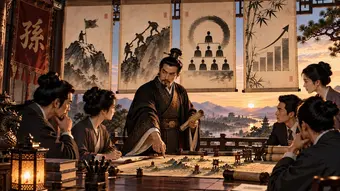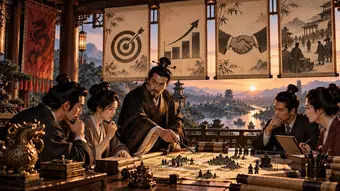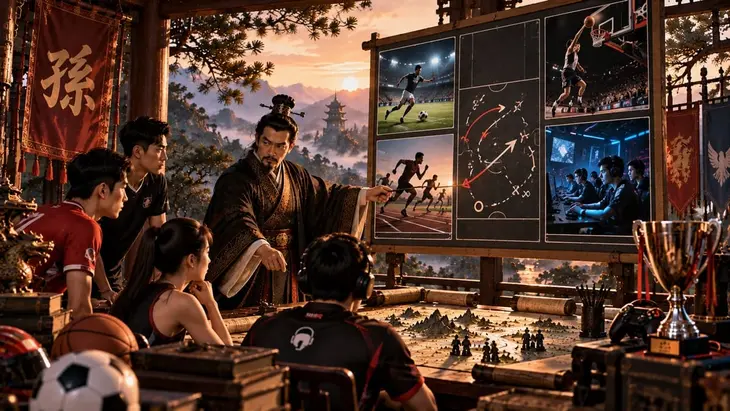
Reading Sun Tzu through sport makes it possible to raise questions about occupying space, the information available, and preparing for a competition. This guide distinguishes team sports, combat sports, eSports, and psychological preparation. The examples are hypothetical, and the parallels are current interpretations, not methods attributed to specific coaches.
Position and timing in team and combat sports
Team sports: reading space before occupying it
In a fictional soccer play, an attacker moves toward the ball and their marker follows. That movement leaves space that another teammate could occupy. The decision is about assessing whether a passing option exists and whether it can be used before the defence reorganizes.
The example makes it possible to separate an apparently open space from a usable opportunity. To examine it, you have to consider where the ball is, what routes the players can take, and what responses the defence has. Noticing a local advantage does not yet explain how the play will end.
The analysis of positioning in team sports develops soccer and basketball situations. Each example keeps the conditions of its discipline: a comparison about spaces does not allow a play to be transferred from one sport to another without reviewing its rules and objectives.
Combat sports: responding to what is observed
Imagine a supervised boxing drill in which one person feints an advance but does not complete it. Their opponent has to interpret what they have seen before deciding whether to change position. The signal may trigger a response, even if it does not fully reveal the intention of the person sending it.
This situation makes it possible to examine the difference between observing a movement and assuming what will happen next. Adapting, within the example, means revising the response when new information appears, rather than following a prepared sequence for conditions that no longer apply.
The reading of adaptability in combat sports addresses feints, changes of pace, and timing choices within a regulated and supervised sporting context. The comparison does not provide instructions for causing injury, nor does it turn a strategic idea into a guaranteed-effective technique.
eSports: deciding with incomplete map information
In a hypothetical digital competition scenario, set in September 2026, two members of the opposing team disappear from the map while the other team considers moving towards an objective. This is a conceptual example, not tied to any specific game or version.
The absence of vision does not confirm where those players have gone. Before agreeing on a move, the team can separate the last observed positions from the movements it only considers possible. The question is what information supports the decision and what risk is being accepted by acting without knowing the rest.
The guide to macrostrategy in eSports organizes the route through information, resources, rotations, and map control. The comparison focuses on coordinating decisions, not on attributing modern video game concepts or mechanics to Sun Tzu.
To develop an example from a specific title, you have to identify its version and the conditions of the match. A mechanic available in one game should not be assumed in another. Nor does a correct action in one situation prove that it must be repeated every time a similar objective appears.
Psychological and tactical preparation before competing
Before a fictional competition, a team reviews the opponent’s footage and prepares a response to behaviour that appears repeatedly. During the match, the opponent acts differently. The preparation exercise must leave room to recognize that difference and decide who communicates the adjustment.
The pre-match analysis allows an expectation to be formed; the competition tests that expectation. It is worth distinguishing what was seen in the footage, what response was practised, and what new information forces it to be reconsidered. Preparing an alternative does not amount to knowing all of the opponent’s decisions in advance.
On the mental side, this example suggests agreeing on how an error will be communicated or a change requested during the match. These are decisions about team preparation, not a validated psychological technique or a promise of performance.
The journey through sports psychological and tactical preparation distinguishes opponent analysis, planning, mental preparation, and decision review. It does not present intimidation as a requirement, nor does it allow a match to be considered won before it is played.
To compare these situations with a reading of the treatise, the analysis of empty and full in chapter 6 offers the route through strengths and weaknesses. The plays in this guide are contemporary examples; their relationship to the text needs to be explained, not taken as proven by a resemblance in vocabulary.
The modern applications of Sun Tzu bring together other routes through business decisions, team leadership, and everyday life. Each field sets different objectives and limits for interpreting the treatise.