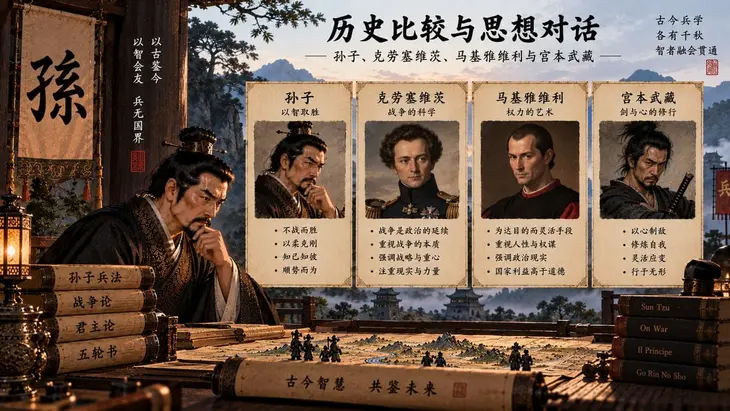
Comparing Sun Tzu with other thinkers requires identifying the problem each work examines. This guide organises four routes through shared questions about objectives, scale, context, information and the limits of combat. It lets you choose a specific comparison without reducing the authors to opposing positions or isolated phrases.
What to compare before setting two authors against each other
A comparison begins by clarifying the objective being examined. Gaining a military position, directing a campaign and preserving the authority of a government are related problems, but they are not interchangeable. Two passages may speak of victory while referring to results of different kinds.
Next, you need to establish scale and context. Does it describe an individual action, a formation or the course of a whole war? What means and command relationships does the argument assume? These questions stop a claim being moved from one field to another without explaining the change.
The role of information and the limits of combat complete the main lines of reading. It is worth observing what the decision-maker needs to know, what uncertainty remains and how the confrontation relates to the aim being pursued. These criteria remain in place throughout the four routes that follow.
Four comparison routes
Sun Tzu versus Clausewitz: ends, information and friction
In On War, Book I, Chapters 6 and 7 examine information and friction. The latter makes it possible to study the difficulties that separate a plan from its execution. The comparison can place those passages in relation to Sun Tzu’s questions about knowledge of the situation, preparation and adaptation.
The route of Sun Tzu versus Clausewitz connects those issues with the purposes of war and the role of combat. The scale of the operation and the context of each work must be preserved during the comparison: recognising a difference in the treatment of confrontation is not enough to describe an author’s whole doctrine.
A reading based solely on indirect warfare versus decisive battle would leave unexamined how each text deals with uncertainty and the relationship between means and objectives.
Sun Tzu versus Machiavelli: government and military organisation
Chapters 12 to 14 of The Prince examine military forces and the ruler’s responsibilities in relation to war. Identifying these passages makes it possible to delimit a comparison about authority, reliance on troops and preparation, rather than attributing a generic position on power to Machiavelli.
The comparison of Sun Tzu versus Machiavelli organises the relationship between government and command. The shared questions are who sets the objective, who directs the available means, what information each person in charge needs and what consequences are considered for the preservation of the state.
When bringing in another work by Machiavelli, it is necessary to identify it and examine its argument separately. A passage from The Prince cannot be swapped without explanation for one from his military treatise, also entitled The Art of War.
Sun Tzu versus Musashi: scale, observation and learning
The route through The Book of Five Rings makes it possible to set out a comparison centred on observation, rhythm, initiative and training. The starting question is what changes when the problem is examined from the practice of an individual or from the coordination of several people.
The reading of Sun Tzu versus Musashi uses those issues to contrast objectives, scale and context. It also asks what information the actor needs and what limits the environment introduces. Before transferring an idea between both texts, the scope of the chosen passage must be checked.
The contrast does not require confining Sun Tzu to the direction of armies and Musashi to duelling as mutually exclusive categories. Nor does a shared point about adaptation, by itself, demonstrate a historical relation of influence.
Sun Tzu versus Jomini: operations, concentration and terrain
Article 21 of Jomini’s Summary of the Art of War distinguishes zones, lines of operation and lines of communication. That terminology provides a concrete entry point for comparing how space, movement and the relationship between positions and objectives are described.
The analysis of Sun Tzu versus Jomini relates those issues to concentration and adaptation. To follow it, it is worth asking what scale is being represented, what conditions the operation assumes and what knowledge of the adversary and the terrain it requires.
A geometric scheme can describe spatial relationships; by itself, it is not enough to determine all the decisions of a campaign. The comparison must examine what role it plays within the work, without turning Jomini into a mathematical formula or Sun Tzu into an exclusively psychological explanation.
How to follow a comparison without losing the context
First choose a question: how information is obtained, what relationship exists between government and command, or how an action adapts to its environment. Then locate the passages in the works being compared and check whether they are dealing with the same problem and on a similar scale.
A coincidence may be partial. Two authors may examine a similar difficulty and propose different answers, or use similar terms for different problems. The comparison needs to explain those differences, not erase them in order to build a simpler opposition.
The Guide to The Art of War makes it possible to recover the context of Sun Tzu’s chapters. Returning to the full argument helps to check whether the contrast is supported by the text or only by a phrase detached from its development.
The strategic philosophy of Sun Tzu organises reading by concepts. It can be used alongside these comparisons to follow the same question across chapters and works, while preserving the reference of each passage.