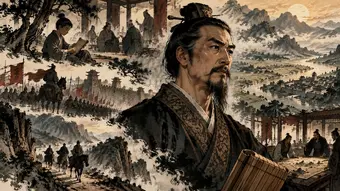
Sun Tzu's philosophy can be studied by following its concepts, without going through the treatise chapter by chapter. This map connects adaptation to circumstances, military deception, knowledge of the situation, and victory without combat. It also suggests criteria for comparing his ideas with those of other strategists.
Adaptability and deception: responding to the situation
Adaptability: revising the response when conditions change
Adaptability consists of adjusting a decision to the circumstances. In the treatise, the comparison with water links the way of acting to the terrain and to the opponent, rather than proposing a fixed arrangement for any encounter.
To interpret that idea, it is worth distinguishing the objective from the way of pursuing it. Revising a procedure does not necessarily mean abandoning the purpose; keeping it also does not justify repeating an action when the conditions that sustained it have changed.
The guide to taoism and strategic adaptability addresses the water metaphor, possible philosophical affinities, and the concept of wu wei. Comparing ideas by itself does not prove a direct historical influence, nor does it allow the treatise to be credited with any Taoist formulation.
Deception: altering what the opponent believes they know
In the military context of the treatise, deception affects perceptions of capabilities and intentions. The opponent makes decisions based on the information they receive and the interpretation they draw from it.
The principles of military deception are studied through appearances of strength or weakness, concealment of intentions, and the use of bait. To distinguish these mechanisms, it is worth asking what information the other side receives and what conclusion it is expected to draw.
This analysis belongs to the military conflict described by the work. Extending it to another sphere requires revisiting its limits: an explanation of disinformation against an opponent is not a general justification for lying or manipulating personal or professional relationships.
Knowledge and victory without combat
To win without fighting: the objective and the cost of achieving it
The treatise gives special value to achieving objectives while avoiding unnecessary destruction. This idea links the outcome of conflict to the cost of the means used to obtain it.
To interpret it, it is worth separating the objective from the confrontation used to reach it. A comparison between alternatives needs to consider what is gained, what is lost, and what possibilities remain open. Avoiding a battle does not automatically mean the conflict has been resolved.
The guide to understanding winning without fighting organises the route through the meaning of this idea, action on plans, and action on alliances.
Self-knowledge: distinguishing capacities, assumptions, and gaps
Knowledge of oneself and of the opponent appears linked to the ability to assess a situation before acting. Knowing one's own resources does not automatically provide reliable information about the other side.
As a reading exercise, it is useful to separate what is confirmed from what is merely assumed. There may also be gaps about the terrain, the time available, or the conditions in which those resources will have to be used.
The section on self-knowledge and strategic information connects those gaps with the review of decisions. The analysis of knowing the enemy and knowing oneself focuses on this idea without turning its formulation into a mathematical guarantee of success.
How to compare Sun Tzu with other strategists
A useful comparison needs a shared question. Before setting two statements against each other, it is worth identifying what objective each author examines, at what scale they work, and in what context they frame their argument. After that, one can study the role they give to information, confrontation, or preparation.
The guide to Sun Tzu versus other strategists gives access to comparisons with Clausewitz, Machiavelli, Musashi, and Jomini. The aim is to examine how the same problem is formulated in different works and contexts.
To follow a comparison, it is worth keeping the reference to the passages and checking what their terms mean within each work. A verbal similarity can hide differences of purpose, while a concrete difference should not automatically be extended to the whole of each author's thought.
Before transferring a concept to a current situation, return to the passage through the guide to The Art of War. The modern applications of Sun Tzu then address that reinterpretation.