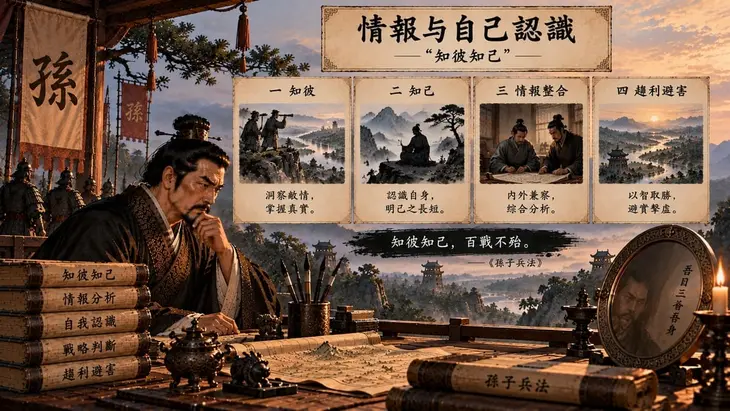
Knowing oneself and knowing the adversary are related tasks, but neither can replace the other. This journey connects the assessment of capabilities, information gaps, and prudence in command. It includes a reading framework to separate what is verified, what is assumed, and what is still unknown.
What we know about ourselves and what we know about the adversary
Self-knowledge: assessing capabilities and limits
Knowing your own resources requires distinguishing between their existence and their availability for a specific task. An inventory may show what resources you have without explaining whether they are ready, how long they can be used, or what conditions limit their use.
The analysis of knowing the enemy and knowing oneself examines the scenarios in the closing passage of chapter 3 of The Art of War. The reference to numerous battles belongs to the structure of the argument; it should not be turned into a percentage of success or a mathematical guarantee.
Self-knowledge also does not mean having high or low confidence in one's own prospects. The question is which claims about those prospects can be supported and which need to be tested.
The limit of knowing only one's own situation
Having internal information does not automatically allow one to infer the adversary's capabilities or intentions. An assessment may describe one's own resources accurately and still be insufficient to decide how to use them against another force.
The journey through the risk of ignoring the enemy focuses on that gap. The distinction is practical: knowing what can be done does not yet answer what can be expected from the other side, or how that response would alter the initial plan.
A matrix of the known, the assumed, and the unknown
As a reading exercise, several areas can be cross-referenced with three states of information. The following scheme is a proposal for organising the analysis, not a literal classification by Sun Tzu. The examples are hypothetical.
- Own resources. We know what equipment appears in the inventory. We assume it remains available. We do not know whether its condition has been checked for the intended task.
- Adversary. We know what activity has been observed. We assume what intention might explain it. We do not know whether there are other means or purposes that have not been identified.
- Environment. We know what conditions an earlier reconnaissance recorded. We assume they are still valid. We do not know what changes have occurred since then.
The value of the framework lies in preventing an assumption from changing category simply because it is repeated. An observation may be correct, and the explanation built from it may be wrong. Information that was valid before may also need updating.
The assessment of the five factors in chapter 1 offers another way to organise the earlier questions. Both exercises can be related without presenting them as a single list from the treatise.
Gathering information and reviewing command judgement
Where the claims come from
Before using a piece of data, it is important to recognise its source and scope. A report about one part of the situation does not necessarily describe the whole. Likewise, having more messages does not resolve a contradiction if they all depend on the same unverified information.
The study of the five kinds of spies in chapter 13 addresses information gathering in the book's military context. It helps distinguish that task from the later interpretation carried out by the commander.
Anger, reputation, and decisions
Chapter 8 examines the commander's vulnerabilities, and the closing part of chapter 12 warns against acting in anger. Reading them together makes it possible to separate the emotion of the moment, the decision that is made, and consequences that may continue after that emotion has changed.
The analysis of the risks of deciding in anger and ego develops those passages. Its purpose is to study command judgement, not to diagnose personalities or turn the treatise into a method for eliminating emotions.
A review question is to check whether the reasons for a decision would still be sufficient without the urgency of responding to a provocation or defending a reputation. This question belongs to interpretive practice and does not replace the assessment of facts.
Sun Tzu's strategic philosophy connects this analysis with other decisions in the treatise. As you continue reading, keep the difference between having information, interpreting it, and acting on it.