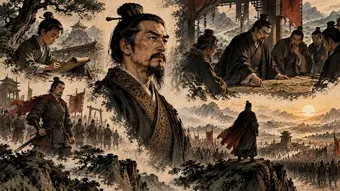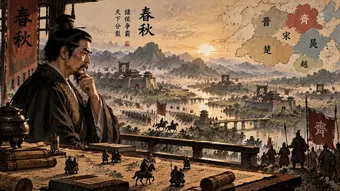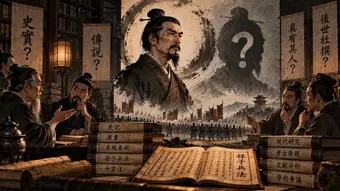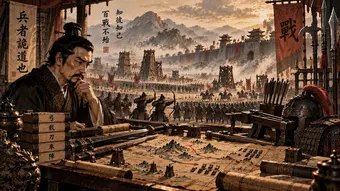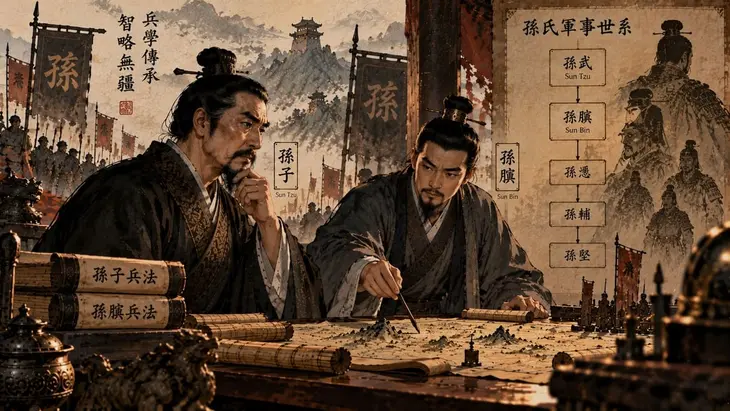
Sun Bin’s career, the Maling episode, and the comparison of the treatises offer different entry points for studying him. This overview makes it possible to connect them without confusing a biographical narrative with military instruction or presenting the relationship attributed to Sun Tzu as a documented genealogy.
Sun Bin’s Career and the Sun Family Tradition
Sima Qian presents Sun Bin as a descendant of Sun Wu and places his activity more than a century after Sun Wu’s death. That is the family relationship transmitted by the Shiji; it should be attributed to the account itself, not confused with a genealogy documented generation by generation.
When studying Sun Bin, it is best to separate the kinship from his own career. The question of his ancestors does not replace an examination of the events associated with his name, nor does it determine how his treatise should be interpreted.
From Pang Juan to Service in Qi
According to Sima Qian, Sun Bin studied alongside Pang Juan, who later caused his punishment and mutilation in Wei. The account continues with Sun Bin’s departure for Qi and the protection of Tian Ji, who brought him into his circle as an adviser.
The reading of the biography of Sun Bin and Pang Juan develops that sequence and examines how the source constructs the relationship between the two. Here, the focus is on placing the main figures; the details of the punishment, the departure from Wei, and entry into military service require a separate analysis of each episode.
To avoid mixing up the figures, also consult the differences between Sun Tzu and Sun Bin. The comparison distinguishes the transmitted biographies and the works attributed to them, without using the similarity of their names as proof of identity.
Maling: The Cooking Fires and Interpreting the Enemy
In the account of Maling, Sima Qian attributes to Sun Bin the gradual reduction of his army’s cooking fires. Pang Juan interprets that decrease as a sign of defections and speeds up the pursuit. The narrative then leads to an ambush prepared at the location chosen by Sun Bin.
The episode makes it possible to distinguish an observation from the conclusion drawn from it. Counting fewer cooking fires is not enough, by itself, to prove that there are fewer soldiers: that conclusion requires assuming a stable relationship between the two. As a reading of the account, the trick consists of manipulating the signal the pursuer uses to estimate the opposing force.
The analysis of the cooking-fire tactic at Maling develops the sequence of the pursuit and the role of the terrain. It should be read as an operation situated in specific circumstances, not as a recipe that will produce the same result against any opponent.
A Separate Treatise for Comparison with The Art of War
What the Yinqueshan Discovery Contributed
In 1972, bamboo manuscripts were recovered at Yinqueshan, in Shandong Province, including texts attributed to Sun Tzu and Sun Bin. The discovery made it possible to study Sun Bin’s work materially again, as it had not survived as a complete treatise within the received transmission.
The overview of the Yinqueshan bamboo manuscripts explains the recovery context and the problems of reconstructing the text. The date of the discovery refers to modern archaeological work; it should not be confused with the date the works were composed.
How to Read Both Books Without Turning One into an Appendix of the Other
One difference noted by Victor H. Mair concerns the form of presentation: compared with the dominance of maxims in the treatise attributed to Sun Tzu, Sun Bin’s includes dialogues and episodes involving historical figures. That difference makes it possible to compare how each work presents and develops its teachings.
The study of Sun Bin’s military treatise organizes that comparative reading. To relate the texts, it is more precise to choose a specific issue—such as the deployment of forces, the information available, or the right moment to act—and examine what each passage says.
Reading them as complementary is the reader’s decision, not a reason to treat them as a single book. A shared theme also does not prove that one work copies the other: the wording, context, and transmission of the passages being compared must all be considered.
When studying Maling alongside the treatises, identify where each statement comes from: the biographical narrative, a military passage, or an editor’s commentary. That separation avoids attributing to Sun Bin’s book every episode told about his life.