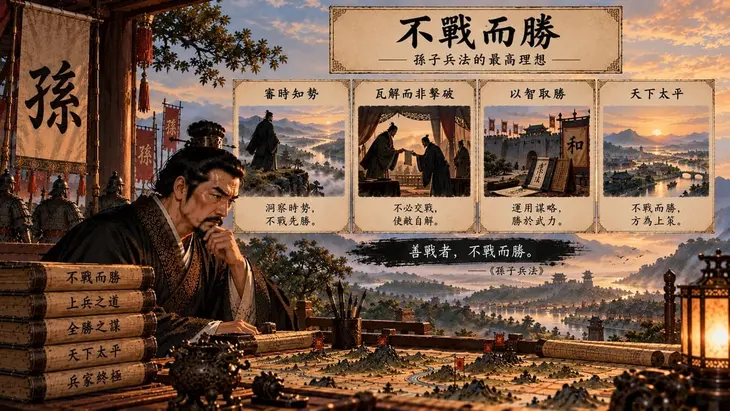
Winning without fighting raises a relationship between the aim of a conflict and the cost of reaching it. This guide sets out the meaning of the ideal, action on plans, and the role of alliances. It also explains why a military reading cannot be transferred without nuance to a modern negotiation.
What winning without fighting means
Chapter 3 of The Art of War contrasts preserving and destroying when examining the results of a campaign. Within that argument, subduing resistance without fighting a battle is valued differently from piling up victories through confrontations.
The question is what one aims to obtain and what is damaged in trying to achieve it. An operation may reach an immediate result and, at the same time, consume the resources needed to make use of it. That is why studying victory also requires looking at the means used.
The analysis of the meaning of supreme military excellence focuses on the maxim and its translations. That commentary makes it possible to examine the ideal without confusing it with a promise that all conflicts can be resolved without violence.
Avoiding a battle does not, by itself, prove that there is no pressure, threat, or subjugation. The military meaning of winning without fighting must not be automatically confused with an agreement between parties that freely accept the same outcome.
Two approaches to reading: plans and alliances
Acting on the opponent's plans
A plan links an objective with the conditions needed to achieve it. Studying it requires identifying what the other side wants, what means it expects to use, and what assumptions support its decision. Observing an isolated move is not enough to reconstruct that whole line of reasoning.
The explanation of what it means to attack strategy develops this approach within chapter 3. The point is to understand how a situation changes when the opponent's project is no longer viable, without turning the concept into a label for any act of pressure.
In a hypothetical reading example, a plan could depend on receiving resources at a particular time. Establishing that this assumption is not met would require revisiting its viability. The example helps identify a dependency; it does not show that knowing it guarantees control over the other side's response.
Examining the role of alliances
Support from other actors introduces a dimension different from one's own capabilities. To analyse an alliance, it is necessary to distinguish its existence, the commitments it contains, and the circumstances in which those commitments could become effective.
The study of the role of alliances in Sun Tzu places this issue in the wording of chapter 3. Later historical examples require their own documentation: mentioning alliances does not allow one to attribute any diplomatic procedure, bribery, or act of discord to the passage.
The reading should also not be turned into a recommendation to isolate people from their relationships. A category from conflict between military forces does not automatically retain its meaning when transferred to everyday life.
The hierarchy of attack and readings of negotiation
Action on plans and alliances forms part of an argument that also examines confrontation with armies and the siege of cities. The hierarchy of attack in chapter 3 makes it possible to read those options within their sequence and recover the relationship between objective, attrition, and preservation.
It should not be used as a mechanical checklist that settles any conflict. A maxim on its own does not provide the information needed to determine what options exist in a specific situation.
In a contemporary reinterpretation, negotiation with a dignified exit raises questions about each side's interests, alternatives, and limits. The link with Sun Tzu is a comparison: preserving a relationship or avoiding escalation requires explaining its own motives, not presenting a modern technique as a literal teaching of the treatise.
The strategic philosophy of Sun Tzu makes it possible to connect this overview with information, adaptation, and deception. Keeping those concepts separate helps distinguish the desired outcome from the mechanisms used to pursue it.