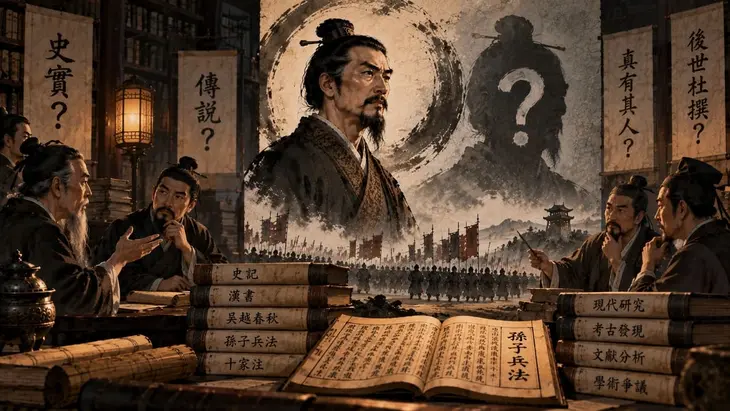
Asking whether Sun Tzu existed is not the same as asking who wrote The Art of War. A historical figure, the accounts of his life, and the formation of a book require different kinds of evidence. This guide organises the debate to distinguish what each source contributes and how far it allows us to go.
The historical figure and the author of the treatise
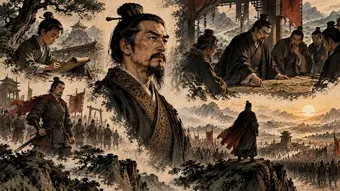
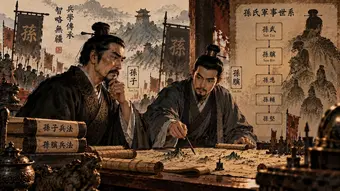
In the Shiji, Sima Qian presents Sun Wu, known as Sun Tzu, as a man from Qi who put his military knowledge at the service of Helü, king of Wu. The account was written several centuries after the period in which the figure is placed.
That temporal distance makes it necessary to separate the questions. A person could have existed without taking part in every episode attributed to him. Likewise, a treatise associated with his name could have incorporated teachings transmitted or reworked later. None of those possibilities should be taken as proven merely because they help explain the gaps.
The study of Sima Qian's records on Sun Tzu examines the biographical testimony and its relation to other sources. To assess its scope, it is worth checking what the historian states explicitly and what his interpreters add.
Questions about the figure's origin have a specific place in the debate on Sun Tzu's origins. Attributing a birthplace to him does not, by itself, resolve when the book that bears his name was composed.
What evidence is used, and what it allows us to conclude
The debate combines narrative testimonies, documentary silences, and ancient materials. Their value depends on the question: evidence useful for studying the circulation of a text may be insufficient to reconstruct a life.
| Evidence | Interpretation | Limitation |
|---|---|---|
| The biography of Sun Wu recorded in the Shiji. | It documents a tradition that identifies him as a strategist in the service of Wu. | A later account is not a contemporary testimony for every episode narrated. |
| The absence of Sun Wu from the account in the Zuo Zhuan of the events of Wu. | This raises doubts about the military role later tradition attributes to him. | The silence of a source does not by itself prove that a person never existed. |
| The military vocabulary and internal organisation of the treatise. | They make it possible to propose dates of composition and examine possible stages of development. | A hypothesis about the formation of the text does not automatically identify its authors. |
| The texts attributed to Sun Tzu and Sun Bin recovered at Yinqueshan in 1972. | They provide material evidence of two distinct textual traditions. | The preservation of an ancient work does not verify every biographical detail attributed to its author. |
Theories of authorship and the distinction from Sun Bin
A historical master, a compilation, or a legendary attribution
Victor H. Mair, in his 2008 study of the treatise, questions its complete attribution to a single author and suggests that the figure of Sun Wu may have been projected into the past from a later tradition. This is a critical interpretation of the formation of the text and of its traditional author, not an established biographical fact.
Another issue is the role of disciples. Sydney Wen-Jang Chu and Cheng-Yu Lee, in their 2013 comparison, examine the possibility that the teachings of masters were gathered by their followers. That proposal does not amount to saying that the masters were fictional.
The survey of the theories about Sun Tzu's authorship distinguishes those hypotheses. Speaking of a compilation, a later attribution, or a collective pseudonym points to different explanations; they should not be treated as interchangeable expressions.
Why Sun Bin requires a separate examination
The similarity between the names and the attribution of military treatises make it necessary to review the differences between Sun Tzu and Sun Bin. The comparison must identify which episodes and which texts belong to each tradition before discussing any possible relationship between them.
To follow the material history of the book, the section on Sun Tzu manuscripts and translations lets us shift the question: from the figure who may have inspired the work to the testimonies that help us study how it was transmitted and how it is interpreted.
When consulting an edition, check whether its introduction distinguishes between the date of the surviving manuscript, the proposed composition date of the text, and the period attributed to the author. These are different matters. An explanation that keeps them separate makes it possible to assess its arguments without relying on a blunt answer about Sun Tzu's existence.