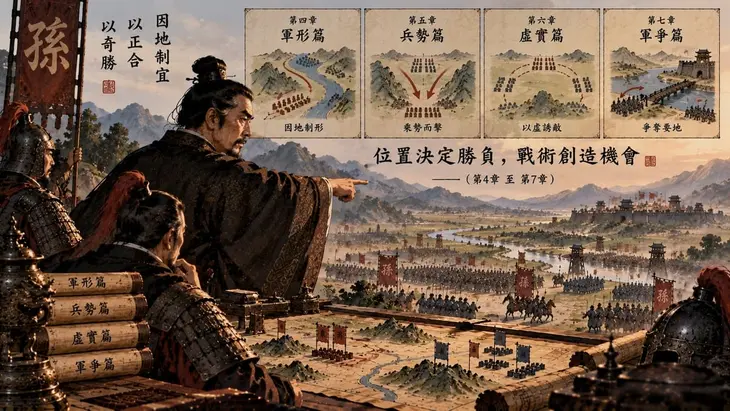
Chapters 4 to 7 allow the move from initial preparation to the study of the deployment of forces and their use. The journey links protection against defeat, coordination, strengths and weaknesses, and the cost of manoeuvres, while keeping separate the concepts each chapter develops.
Preparing the position and coordinating the forces
Chapter 4: dispositions and the opportunity to act
Chapter 4 of The Art of War distinguishes one’s own preparation from the opportunities offered by the opponent. Reducing the weaknesses of one’s own army belongs to a different task from finding a favourable occasion to act. Preparing does not oblige one to attack immediately.
The study of the dispositions of chapter 4 examines that difference between what depends on command and what requires observing the opponent. Invulnerability must be read within this argument about defensive preparation, not as a literal promise that an army can be free from all risk.
Chapter 5: Shi, Zheng and Qi
The next chapter introduces the problem of organised force. The capacity of a whole is not explained simply by adding individual capacities together: how its components are arranged and coordinated also matters. The study of Shi is linked to that configuration and to the potential it allows one to develop.
Zheng and Qi raise another distinction, associated with the combination of forms of action usually presented as orthodox and unorthodox. The analysis of Shi, Zheng and Qi in chapter 5 develops their terminology. They should not be treated as three names for the same idea, nor reduced to force, surprise and creativity without examining the passage.
Reading strengths and assessing movement
Chapter 6: empty and full
Chapter 6 relates initiative to the concentration and distribution of forces. Studying weak and strong points requires observing how both sides of the situation are organised: where one’s own capability is concentrated, where the opponent’s is dispersed, and what changes alter that relationship.
The reading of empty and full in chapter 6 allows one to follow that argument. A position should not be described as strong or weak without considering the conditions under which it would have to act. Adaptation comes precisely when those conditions cease to be the ones expected.
Chapter 7: manoeuvres, routes and effort
Movement adds a cost to the search for an advantage. Shifting a force requires preserving its coordination and assessing the effort of the route. Reaching a place before the opponent loses some of its meaning if the move prevents the forces from being used as intended.
The analysis of the manoeuvres of chapter 7 relates routes, expected advantage and the limits of movement. Here, references to the direct and the indirect need to be read in the context of marches, without automatically transferring the definitions used when studying Zheng and Qi.
How to relate the concepts without confusing them
A disposition describes how a force is prepared; a manoeuvre, how it moves or acts. The configuration may favour an action, but it does not remove the need to recognise when it is suitable. Likewise, changing route does not by itself amount to changing the tactical function of a force.
To follow the full reasoning, the block on strategic preparation: chapters 1 to 3 explains the assessment made before using the means. The continuation in terrain and adaptation: chapters 8 to 11 incorporates the command decisions, observation and the army's circumstances.
See the guide to The Art of War to place these chapters within the treatise. When comparing editions, check how each one translates the tactical concepts before interpreting two different terms as equivalents.