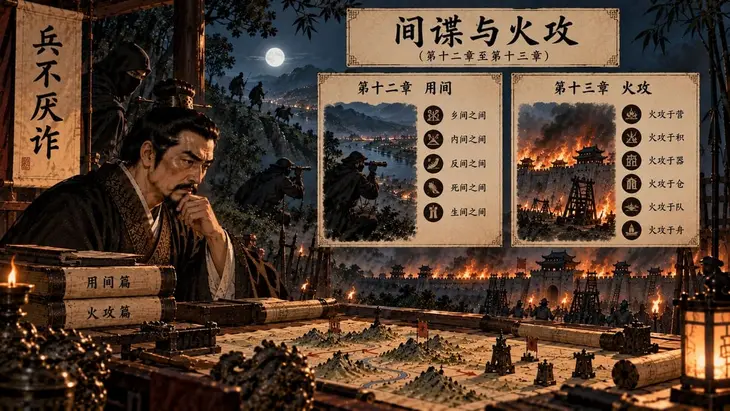
The final two chapters of The Art of War deal with the use of fire and the gathering of information. This overview offers a separate entry point to each theme and connects prudence in action with the need to know the situation, without turning the historical reading into a manual of weapons or espionage.
Chapter 12: fire and prudence in attack
Chapter 12 examines fire attacks and ends with a warning about decisions driven by anger. Both themes are part of its reading: describing a means of attack does not resolve when it is appropriate to use it or what consequences doing so would have.
The difference can be set out through two questions. The first is what capability a force has; the second is what objective justifies using it in a specific situation. Confusing them would lead to treating the availability of a means as sufficient reason to act.
The analysis of the fire attacks in chapter 12 develops the text's classification and its final warning from a historical perspective. The focus is on understanding the argument and its limits, not on reconstructing technical methods of harm.
Prudence also introduces a difference between a passing emotion and the effects of a decision. To interpret the passage, it is important to examine which reasons support the action and which depend solely on the reaction of the moment.
Chapter 13: the value of knowing the situation
Chapter 13 deals with spies and access to information about the adversary. The preparation of a campaign can be compromised when its decisions rest on assumptions that have not been checked. The text thus links the gathering of knowledge with the resources that conflict requires.
The overview of the five types of spies in chapter 13 distinguishes their functions and their relationship to information. Studying them requires more than memorising names: the point is to recognise how a piece of information reaches command and what role it plays within the argument.
The gathering and the interpretation of information must also be kept separate. Receiving information does not automatically determine what it means, nor does it eliminate the possibility of error. To examine a claim, you can ask where it comes from, what it allows you to know, and which aspects remain unclear.
This reading keeps espionage within its military context. The classification of agents should not become a guide for accessing systems, obtaining secrets or intervening in other people's lives.
From military intelligence to its reinterpretations
What is known, what is assumed and what is missing
The chapters make it possible to pose a shared question: what is actually known before acting? Having one's own means does not in itself provide knowledge of the adversary, and knowing part of the situation does not mean understanding the whole of it.
The section on self-knowledge and strategic information develops that distinction. It allows us to study the relationships between one's own capabilities, ignorance of the other side and assumptions that may influence a decision.
The comparison with competitive intelligence
A contemporary adaptation can focus on gathering, checking and interpreting public information. That exercise has a different scope from the espionage described by the treatise: the actors, the means and the context of the activity change.
The reading of competitive intelligence with open sources presents that journey as a reinterpretation. The parallel lies in examining the information that supports a decision; it does not make public-source analysis equivalent to the covert obtaining of secrets.
To recover the context of observation and adaptation that comes before these chapters, see terrain and adaptation: chapters 8 to 11. The The Art of War guide lets you return to the treatise as a whole and to the study of its translations.