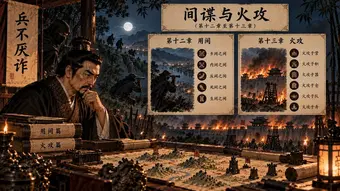
The opening chapters of The Art of War examine the conditions of a campaign before developing its manoeuvres. This overview connects the initial assessment, prior calculations, economic strain and the priorities of attack. Chapter 1 has two reading entry points: its five factors and the meaning of winning in the temple.
Before acting: assessing conditions and reviewing the calculations
Preparing a strategy requires distinguishing between wanting to achieve an objective and having the conditions to try. Chapter 1 of The Art of War opens this assessment through factors that allow one to compare one's own situation with that of the opponent. Planning begins with questions about circumstances and available means, not with the choice of a manoeuvre.
The five factors of chapter 1
Doctrine, timing, terrain, command and discipline organise the initial assessment. Each factor directs attention to a part of the problem: the conditions of the environment are not the same as the ability to lead, and having resources does not mean having them organised for use.
The analysis of the five factors of chapter 1 develops their meanings and the questions each one raises. Comparison requires concrete information; assigning a favourable rating to all factors without justifying it would merely give the appearance of calculation to an expectation.
What it means to win in the temple
The passage on prior calculations introduces another question: how a forecast is formed before forces are mobilised. Identifying the factors that need to be examined is a first step. Afterwards, conditions must be compared, what information is missing must be recognised, and why a particular outcome is expected must be explained.
The reading of what it means to win in the temple focuses on that preparation. Planning allows assumptions to be reviewed before committing resources, but it does not eliminate changes in circumstances or turn a forecast into a guaranteed victory.
Cost and priorities: what it takes to sustain a campaign
Chapter 2: mobilisation, supply and attrition
The second chapter shifts attention to the effort involved in maintaining war. A campaign needs resources at its start and throughout its course. Duration alters that effort: supply needs continue while equipment and forces suffer attrition.
The study of the cost of war in chapter 2 links mobilisation, supplies and the prolonging of conflict. Its reading allows a practical distinction to be revisited: being able to begin an operation does not prove that it can be sustained until its objective is reached.
Chapter 3: the options for attack
Chapter 3 distinguishes action against plans, alliances, armies and fortified cities. Its argument requires consideration of what is intended to be achieved and what cost the chosen way of doing so introduces.
The explanation of the hierarchy of attack in chapter 3 develops those priorities together with the relationship between information and command. Reading the chapter only as a collection of phrases about winning without fighting would leave out the comparison between alternatives that underpins its reasoning.
From initial assessment to the deployment of forces
The three chapters can be read as a successive review of the same decision. First, the conditions are examined; then, the cost of maintaining action; finally, the means of pursuing the objective. A conclusion reached at the outset must be reconsidered if the costs or alternatives change.
For example, in a hypothetical situation, having enough forces to set out would not solve a shortfall in supplies needed to continue. That difference would force the plan to be reviewed before its execution is discussed. The next section, positioning and tactics: chapters 4 to 7addresses defensive preparation, coordination and manoeuvres.
The The Art of War guide brings together the other chapter sections and the journey through manuscripts and translations. It lets you follow the order of the treatise or return to a specific topic without losing its connection with the whole.